How to Tell if a Hot Wheels Is a Treasure Hunt or a Super Treasure Hunt
November 3, 2026
Short answer: look at the car, not only the card. A regular Treasure Hunt is a normal mainline car (regular paint, plastic wheels) with a small flame-in-a-circle logo printed in its graphics, and the same logo printed on the card behind the car. A Super Treasure Hunt has Spectraflame paint, Real Riders rubber tires and a small “TH” logo on the car, and on current cards a gold circle flame behind it. As of November 2026, Hunt64 collectors value the typical regular Treasure Hunt at $5.56 and the typical Super at $72.47, against $3.77 for a plain mainline car.
Below: what to check on the card and loose, how the rules changed since 1995 (most of the confusion comes from older cars), the mistakes and fakes that catch people out, and what each tier is worth in our data.
The three tiers side by side
| Plain mainline | Regular Treasure Hunt | Super Treasure Hunt | |
|---|---|---|---|
| Paint | Regular paint, sometimes metalflake | Regular paint, sometimes metalflake | Spectraflame: see-through color over a bright metal finish |
| Wheels | One-piece plastic | One-piece plastic | Real Riders: a rubber tire on a separate rim |
| Mark on the car | None | Circle-flame logo in the graphics | Small “TH” logo in the graphics |
| Mark on the card | None | Silver circle flame behind the car | Gold circle flame behind the car |
| Collector number | Its own | Its own, with no plain twin that year | Shares the number (and usually the card art) with a regular car |
| How many in 2026 | The other 235 of 250 numbers | 15 | 15 |
| Typical value, Hunt64 median | $3.77 | $5.56 | $72.47 |
The values are medians across every casting in each tier that has a published community median, as of November 2026. More on them further down.
On the card: a regular Treasure Hunt
- Find the circle flame on the car. It is printed as part of the car’s graphics, and Mattel moves it around: sides, doors, hood, nose, trunk, sometimes worked into the design. On the 2026 ‘87 Buick Regal GNX it sits inside the “87” on the sides; on the 2026 Nissan Skyline HT 2000GT-X it is a small red logo on the rear fenders. Our 2026 Treasure Hunt list shows where it is on all 15 of this year’s cars.
- Look behind the car. The same logo is printed on the card art behind the car, where the car itself mostly hides it. Tilt the card and look past the car through the blister. On a regular Treasure Hunt it is silver.
- Use the number. Since 2013 a regular Treasure Hunt is its own numbered mainline release, so there is no plain-wheel lookalike of it that year. If you know the year’s 15 Treasure Hunt numbers, the collector number in the top corner of the card is the fastest check on a crowded peg.
Collectors also call the circle flame the “low-production symbol”. It is the same logo on the car and on the card.
On the card: a Super Treasure Hunt
A Super is hidden differently. It is one of the year’s regular releases given the Super treatment, so it shares the collector number and usually the card art with the regular car hanging next to it. A glance at the card is not enough. Look at the car:
- Real Riders. A rubber tire on a separate rim instead of a one-piece plastic wheel. Through the blister this is usually the fastest tell.
- Spectraflame paint. Mattel’s name for a see-through lacquer over a bright metal finish, the look of the original 1968 to 1972 Hot Wheels. Next to the regular release it glows, with a depth that ordinary paint does not have.
- A “TH” logo on the car. Small, and placed differently on every car: sides, rear fender, doors, even a license plate (the 2026 Ford Mustang GTD has it on the rear plate, the 2026 Custom Otto a faint “ghost” TH on the front fender).
- The gold flame. On current cards a gold circle flame is printed behind the car. It is a helpful confirmation, but the car is the proof.
Here is the 2026 Ferrari F40 Competizione, regular and Super. Same number (63/250), same card art:
| Version | Toy # | Paint and wheels | Paid | Valued at | |
|---|---|---|---|---|---|
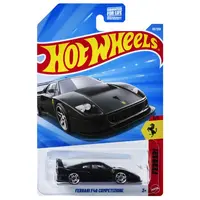 | Regular | JJJ31 | Black paint, plastic wheels | $3.78 | $11.11 |
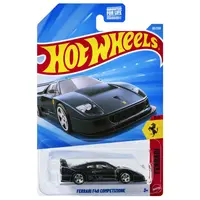 | Super Treasure Hunt | JJM17 | Spectraflame dark gray, Real Riders | $3.11 | $182.79 |
On the card they are easy to mix up at arm’s length. Up close, the Super’s gray metallic finish and rubber tires give it away. Both were mostly found at shelf price (median paid about $3), and 254 collectors value the regular one at $11.11 against $182.79 from 64 collectors for the Super.
Loose: when there is no card to help
- A loose regular Treasure Hunt has one mark: the circle-flame logo on the body. Paint and wheels are ordinary. Because the logo also appears on cars that are not Treasure Hunts (see the mistakes below), check the casting, color and year against that year’s list.
- A loose Super should have all three: Spectraflame paint, Real Riders and the TH logo. Rubber tires alone prove nothing, because premium lines such as Car Culture and Pop Culture have Real Riders and usually a metal base as well (how the lines differ). Modern Supers sit on the mainline casting; all fifteen 2026 Supers have plastic bases.
- The base code will not help. The letter and digits stamped on the base are a production date, not a rarity mark. Our base code decoder explains what they do tell you.
How the rules changed
Most “is this a Treasure Hunt?” arguments are about older cars, because the system changed three times.
1995 to 2006: a separate series. Hot Wheels launched Treasure Hunts in 1995 as their own 12-car series, each car limited to 10,000 pieces and sold on a card with a green Treasure Hunt bar. The figure rose to 25,000 in 1996 and was dropped after that. From 1997 most of them had special wheels, usually Real Riders. Supers did not exist yet, so an old Treasure Hunt with rubber tires is a regular Treasure Hunt of its era, not a Super.
2007 to 2011: two versions on two cards. The Treasure Hunts stayed a numbered series (in 2007, numbers 121 to 132 of 180), but each car now came in two versions. The regular one had ordinary paint and plastic wheels. The far rarer Super had Spectraflame paint and rubber tires, and its card spelled the series name “TREA$URE HUNT$” instead of “TREASURE HUNTS”. There were 12 a year through 2010 and 15 in 2011. The 2007 Supers are known for paint that flakes off.
2012: the Supers go undercover. Supers left the Treasure Hunt series and were hidden inside the regular mainline series: any mainline car could get Spectraflame, Real Riders and the TH logo. The regular Treasure Hunts stayed a 15-car series for one more year.
2013 to today: everything hidden. From 2013 the regular Treasure Hunts were hidden too. Random mainline cars got the circle-flame logo on the car and on the card, and both tiers have been about 15 cars a year since. The Super’s card logo was printed in black at first and has been gold since the mid-2010s. According to the Hot Wheels fandom wiki, a full 72-car case typically holds one regular Treasure Hunt, while not every case holds a Super.
Common mistakes
- Treating any circle flame as a Treasure Hunt. Premium and other lines reuse the logo as decoration, and before 2013 it meant nothing. It only marks a Treasure Hunt on a mainline car from 2013 on.
- Trusting the package over the car. In 2015 a regular Fiat 500 shipped with the Treasure Hunt logo printed on its packaging but not on the car. It is not a Treasure Hunt. The car decides.
- Mistaking metalflake for Spectraflame. Two 2026 regular Treasure Hunts, the ‘87 Buick Regal GNX (metalflake purple) and the 2 Jet Z (metalflake gold), sparkle on the peg. They still have plastic wheels and no TH logo, so they are regular Treasure Hunts, not Supers.
- Assuming rubber tires mean Super. See the loose section above: premium cars and customs have them too.
- Paying Super money for a regular Treasure Hunt. Listings call regular Treasure Hunts “rare” all the time. Collectors value the typical one at $5.56.
Fakes and customs
Customizing is a big, legitimate part of the hobby. People drill out the rivets, strip a mainline car, repaint it in candy colors and fit Real Riders. Sold as a custom, that is fine. The trouble starts when a custom is sold as a Super, which almost always happens with loose cars. Before you pay Super money for a loose car:
- Check the base. Factory cars are riveted shut, and swapping wheels or repainting means taking the base off. Drilled rivets, screws or glue around the posts mean the car has been apart.
- Check the details against the factory record. Every Super has a documented wheel style, base color, graphics layout and TH logo position; the fandom wiki lists them year by year. The 2026 F40 Super, for example, has Real Riders, a TH logo on the sides and a black plastic base. Repaints tend to lose or blur the printed graphics and leave paint on the windows or the edge of the base.
- No TH logo, no Super. Candy paint and rubber tires without the logo usually means a custom or a premium car.
- Carded cars: the blister should be flat and evenly sealed all the way round. Lifted edges, cut marks or glue residue are reasons to walk away.
What they are worth
All figures are Hunt64 community medians as of November 2026: for each casting, the median of what collectors paid and what they value it at, published once at least five collectors have contributed. The “typical” value below is the median across every casting in the tier that has one.
| Tier | Castings with a value median | Typical paid | Typical valued at |
|---|---|---|---|
| Plain mainline (no TH, Super or chase) | 1,223 | $2.60 | $3.77 |
| Regular Treasure Hunt | 58 | $2.68 | $5.56 |
| Super Treasure Hunt | 36 | $14.03 | $72.47 |
For 2026 alone the picture is the same: plain mainline $3.09, regular Treasure Hunt $5.41, Super $67.01.
- A regular Treasure Hunt is worth about one and a half times a plain car. It is a fun find and good for set completion. The most valued regular Treasure Hunt in our data, the 2022 ‘58 Impala, sits at $17, and that from only five collectors.
- A Super is worth about 19 times a plain car, and about 13 times a regular Treasure Hunt. The median paid of $14.03 blends the collectors who found theirs on the pegs for a few dollars with the ones who bought from resellers.
- Every Treasure Hunt and Super with a median is from 2013 or later. Older ones have not reached five contributing collectors yet, so we do not have numbers for them. That is the honest limit of community prices: many castings, especially older ones, have none.
The numbers come from 74,500+ purchase prices and 78,700+ valuations recorded by 9,300+ Hunt64 collectors, in their own currency and converted to US dollars. Each collector counts once per casting, and nothing is scraped from listings. The method is explained in what Hot Wheels are really worth, and every casting with a median has its prices in the Hunt64 app.
If you think you found one
- Check this year’s lists. All fifteen 2026 regular Treasure Hunts, with pictures and where the flame sits on each, are in our 2026 Treasure Hunt list. The Supers are in the 2026 Super Treasure Hunt list.
- Log it the day you find it. The Hunt64 scanner reads the card and marks Treasure Hunt and Super releases in the match. Because a Super shares its card with the regular car, look at the car before you confirm which version you have. Hunt64 is free on iPhone and Android, and your price counts toward the community medians once you add it.
Frequently asked questions
How do I know if my Hot Wheels is a Treasure Hunt?
On a mainline car from 2013 or later, look for a small flame-in-a-circle logo printed in the car's graphics. On the card, the same logo is printed behind the car. A Super Treasure Hunt is different: it has Spectraflame paint, Real Riders rubber tires and a small TH logo on the car, and a gold circle flame on the card.
What is the difference between a Treasure Hunt and a Super Treasure Hunt?
A regular Treasure Hunt looks like any mainline car apart from the circle-flame logo: normal paint, plastic wheels. A Super has Spectraflame paint, Real Riders rubber tires and a TH logo, and is made in much smaller numbers. As of November 2026, Hunt64 collectors value the typical regular Treasure Hunt at $5.56 and the typical Super at $72.47.
What does the flame in a circle mean on a Hot Wheels car?
On a mainline car from 2013 onward it marks a Treasure Hunt. Collectors also call it the low-production symbol. On premium and other lines, which reuse it as decoration, and on cars made before 2013, it means nothing.
Is a Hot Wheels with rubber tires a Super Treasure Hunt?
Not on its own. Premium lines such as Car Culture and Pop Culture have Real Riders rubber tires too, and customizers fit them to mainline cars. A real Super has rubber tires, Spectraflame paint and a TH logo, on a mainline car.
How many Treasure Hunts are there each year?
In most years since 2013, 15 regular Treasure Hunts and 15 Super Treasure Hunts, hidden across the year's mainline case mixes. 2026 follows that pattern: 15 of each.
How much is a regular Treasure Hunt worth?
Not much more than a normal car. Across 58 regular Treasure Hunts with published medians, Hunt64 collectors value the typical one at $5.56, against $3.77 for a plain mainline car, and the median price paid was $2.68, about shelf price. Figures as of November 2026.